How I find the one thing that matters
Before you spend money on the wrong thing.
Advisory is a trust business. You need to trust the person you're choosing and believe they can actually move your business forward.
This page shows how I work. I find the ONE THING that matters. I first check whether AI is about to change what you sell. Then I check everything else.
You'll see what I need from you and what you get at the end, so you can decide before we talk.
“Mark does not prevaricate. He takes a considered approach and will always seek to move forward at pace.”
Edwin Side, Sales leader, Gearset
One method, two questions
Where every piece of work starts
It always comes down to finding the ONE THING
First
Second
Can AI already do what your customers pay for?
What can move your business forward?
How much of what customers pay you for can AI already do, what's left that it can't, and roughly how long have you got to rebuild around it? The answer tells us your one thing to work on.
I look in eight places, starting with your market and working inwards, and I go on evidence, not opinion. That shows whether AI is really the priority.
Answer them in this order. Check whether AI is about to change what you sell before you spend money fixing other things. If AI turns out to be the ONE THING, that's where we start our work. AI for the right reasons.

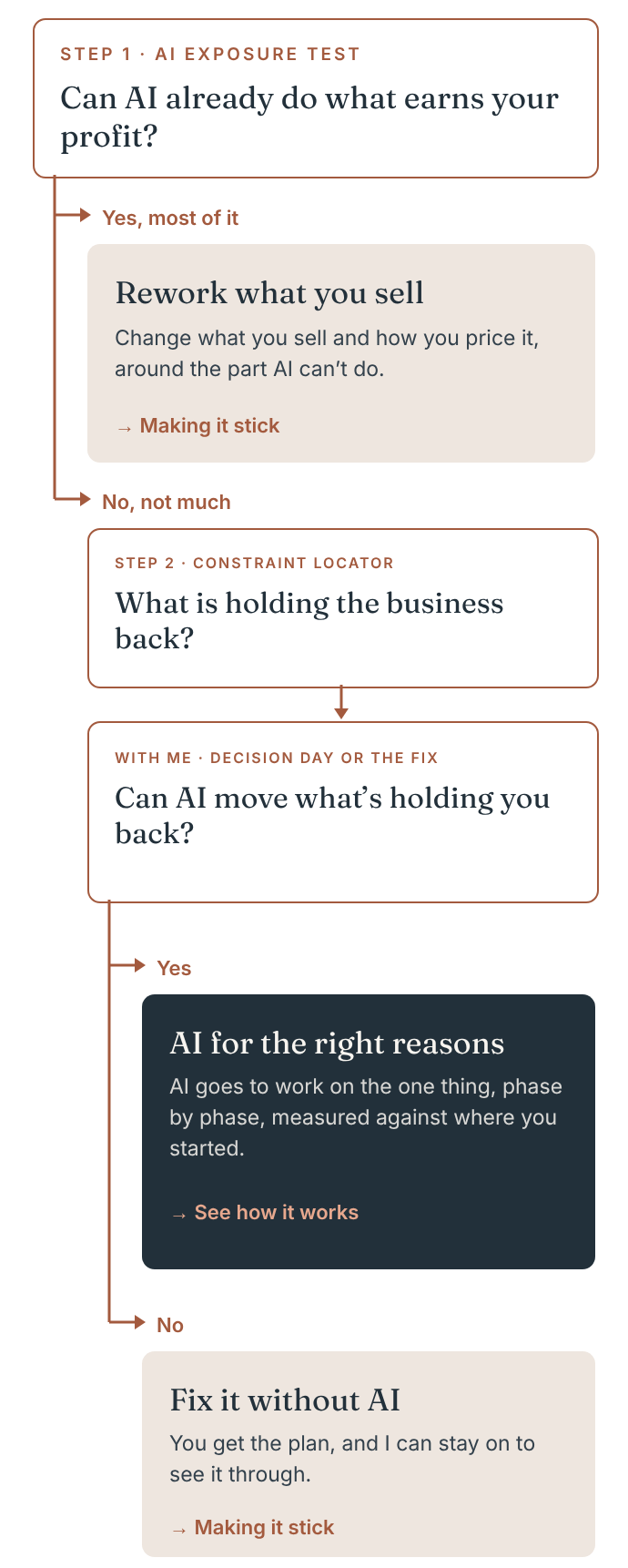
AI for the right reasons
The AI Exposure Test
You get how much of your profit is at risk, the part of the business AI can't copy, and roughly when it starts to bite, all worked out from your own figures.
Step 1
What AI can already do
We take each thing you sell, by the profit it makes, and ask whether someone good with today's AI tools could produce it. Then the same test against eighteen months ago, because the useful signal is how far the line has moved.
Step 2
Who stops needing you
For each type of customer we ask two things: can AI already do the work, and would they do it themselves? Only one of the four answers puts you out of business.
Step 3
Where you're actually different
Six things AI struggles to copy: data only you hold, being the one accountable, being there in person, being trusted when the stakes are high, your place in the market, and your route to customers. Expertise is not on that list, and that is the uncomfortable part.
How your customers replace you
Customers rarely replace you in the way you're watching for. We test each route against your actual accounts.
1. Your customer runs it through their own AI and keeps the easy work.
2. A competitor's AI lets them quote a number you can't match.
3. A new company built around AI turns your whole market into a price war.
4. The AI or software everyone already uses starts doing the work you charge for.
The verdict is three lines. The share of gross profit AI can already reproduce. The one thing it can't. And how long you have, unless you can't tell, which is the honest answer for most businesses.
The One Thing
How I find the one thing that can move your business forward
There are three rules, eight places to look and one answer. The rules matter most, because they stop you drawing up a shopping list of problems when what you need is the ONE THING that can move your business forward.
Start outside
AI, market & what you sell first. Only then how the business runs. There is no point tidying up the inside of a business when the problem sits outside it, and most improvement programmes do exactly that.
Symptoms aren't the cause
Talent, systems, brand and leadership come up in every conversation. They're real problems, and they often explain why one of the eight is stuck, but they're symptoms. I note them and keep looking.
And neither is AI
AI changes your market, what you sell and the margin you can hold, so that's where I look for it. If you treat AI as a problem in its own right, you'll end up running an AI project that isn't tied to the thing actually holding you back.
Find the one thing
There may be ten things showing up. Find the one that matters most. You get one answer instead of a ranked list of twenty recommendations you'll never get through.
Gather the Evidence
When we can't tell without the numbers, we write a question mark and go and get them. Every question mark becomes a measurement instead of a gap in the argument.
Eight places the one thing sits
Two outside the business, six inside it. For each one I say whether it's holding you back, might be, isn't, or can't tell yet, and how sure I am.
1B. Your market
Your growth against the market's numbers, in real terms. Then the harder question: what market are you in, and why?
3. Demand
Are people sitting idle, and is enough work coming in for the share you actually win? Most owners assume this is the problem. It usually isn't.
5. Retention
How much of this year came from last year's customers. A leaking bucket looks exactly like a small tap.
7. Operations
Work piling up, lead times increasing, quality dropping. People usually get the blame, and usually it isn't them.
2. What you sell
When a buyer has other options, do they choose you? Seven tests, including who you now lose to and why.
4. Win rate
What share of proposals convert, why you lose, and who to. More leads into a broken process makes things worse.
6. Profit
What you make on each job, prices against costs over three years, and whether you're discounting more than you were.
8. Cash
Days between doing the work and being paid, months of reserve, and what borrowing would actually cost. Cash kills fastest.
1A. AI Exposure
Can AI replace what you sell? Are customers doing it themselves?
Your side of it
What I need from you
I send you the list below as an evidence request before anything starts. Nothing here is unusual and none of it needs preparing. If it exists, send it as it is.
WHAT TO SEND ME
-
Revenue by line, product or service, three years
-
Gross profit by the same split (this is the one that matters most)
-
Delivery margin by job or contract, if you have it
-
Debtor days, creditor days, stock turn, cash position and facility
-
Your top twenty customers and what each of them buys
-
Twelve months of pipeline with win and loss reasons
-
Key people for forty-five minutes each, without you in the room
-
Whatever strategy or plan currently exists, however out of date
-
Any customer research from the last two years
-
The thing you already suspect is the problem, written down before we start
If you can't produce some of this, that tells us something too. Get your team working on the gap. It's valuable work, and it helps us find the one thing.
WHAT YOU GET
What lands on your desk
Named documents, not "a report". I write every one of them to be handed to someone who will act on it.
-
The Constraint Locator: what will move your business forward and why, checked across all eight places
-
The AI Exposure Test: how much of what you sell AI can already do, what it can't, and how long you have to react
-
Action report: what work needs doing, by whom and ideally by when, to move the one thing.
-
Evidence pack: every number I used and where it came from, the analysis I did and any assumptions, so anyone can check my work.
Every engagement also ends with a copy of the methodology used, so it stays in the building after I've gone. You can then run the process again next year, yourself.
What it asks of you
This is what I'll need from you. If you can't give it, better we both know now.
Your own time, quality time
Time with your people, without you in the room
Half a day up front, a full day in the room, and an hour a week while the work runs. You can't delegate this. The person who can act on the answer needs to be there while it takes shape.
The relevant members of your team, forty-five minutes each, on the understanding that I attribute nothing to anyone. You get themes, never names. I won't bend on this, because the version of the truth people give in front of the boss isn't the useful one.
Numbers that may take some digging out
Margin by job, lost deals with honest reasons, and gross profit by line. If these don't exist we'll build them, and that becomes part of the work rather than a reason to avoid it.
A commitment at the end
The answer is often not where you expected, and acting on it usually means stopping something you're attached to. If the organisation can't make that decision, the diagnosis is an expensive piece of paper.
And what I won't do
-
Hand you twenty recommendations and call it a strategy.
-
Tell you the answer is more leads, unless it genuinely is.
-
Sell you an AI programme that isn't attached to the thing holding you back.
-
Using AI comes second. First we work out how AI will hit what you sell, or you could end up automating away the thing customers pay you for.
-
Leave a report behind with no plan attached to it.
-
Stay longer than the work needs. I am not here to create more work for myself. Every engagement has a defined end, written down before it starts.
-
Take on work that isn't mine to do, like sales training. I'll find you someone who's good at it.